Product catalogue design examples: what goes on each page
A 16-page product catalogue taken apart page by page, with what each page does, how buyers use a catalogue and what makes one easy to order from.
A product catalogue has one job: let a buyer find a product, check that it fits, and order it without writing back to ask a question. Every email a buyer has to send ("what size is this?", "does it come in teak?") is a chance for them to order from someone else instead.
Below is a catalogue from our studio, taken apart page by page. It is a 16-page export catalogue for Sanjha Woodworks, a fictional furniture maker in Jodhpur: 29 pieces in five collections, made for buyers abroad. You can turn every page of it.
What every product catalogue needs
- a cover that says what the range is and how big it is;
- who you are and how to read the catalogue;
- the products, grouped the way a buyer shops;
- for every product: a code, a photograph, sizes, materials and finishes;
- materials and care;
- custom orders, if you take them;
- how to order: minimum quantities, packing, lead times and delivery terms;
- contact details.
The cover: the size of the range
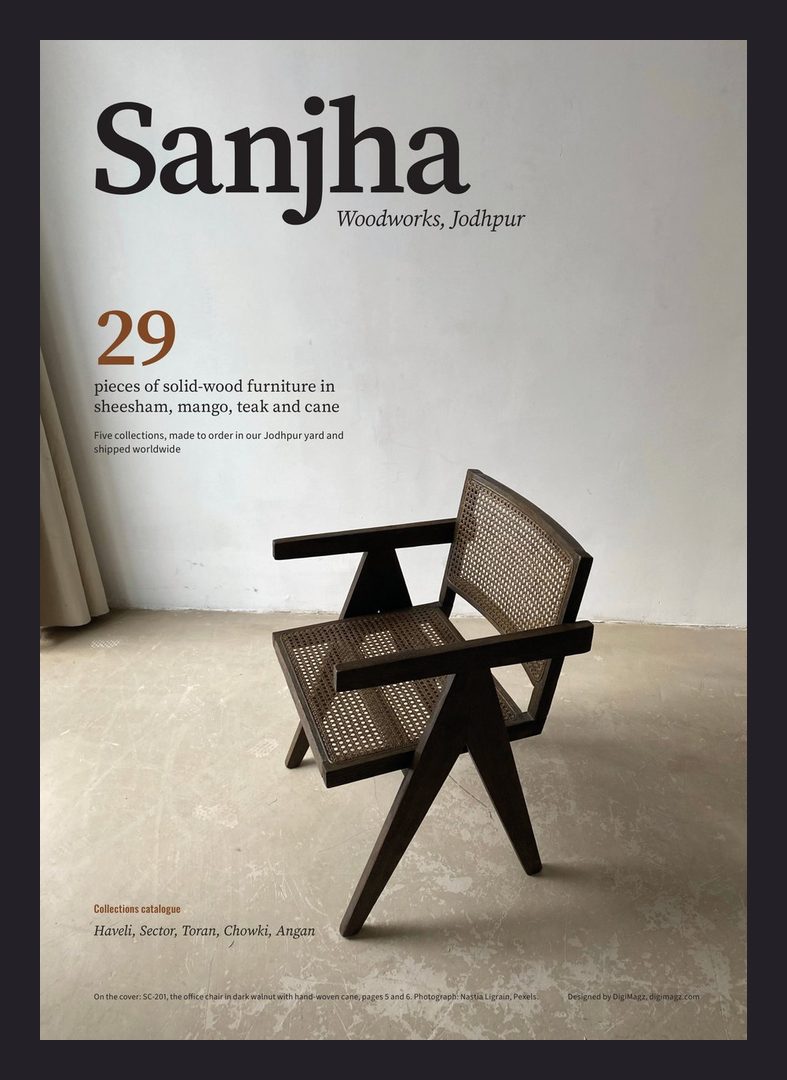
The Sanjha cover shows one chair and one number: 29 pieces of solid-wood furniture. A buyer knows at once what kind of catalogue this is and how much there is inside. A catalogue cover does not need ten products on it; one well lit product and one fact do more.
Each collection opens with one picture
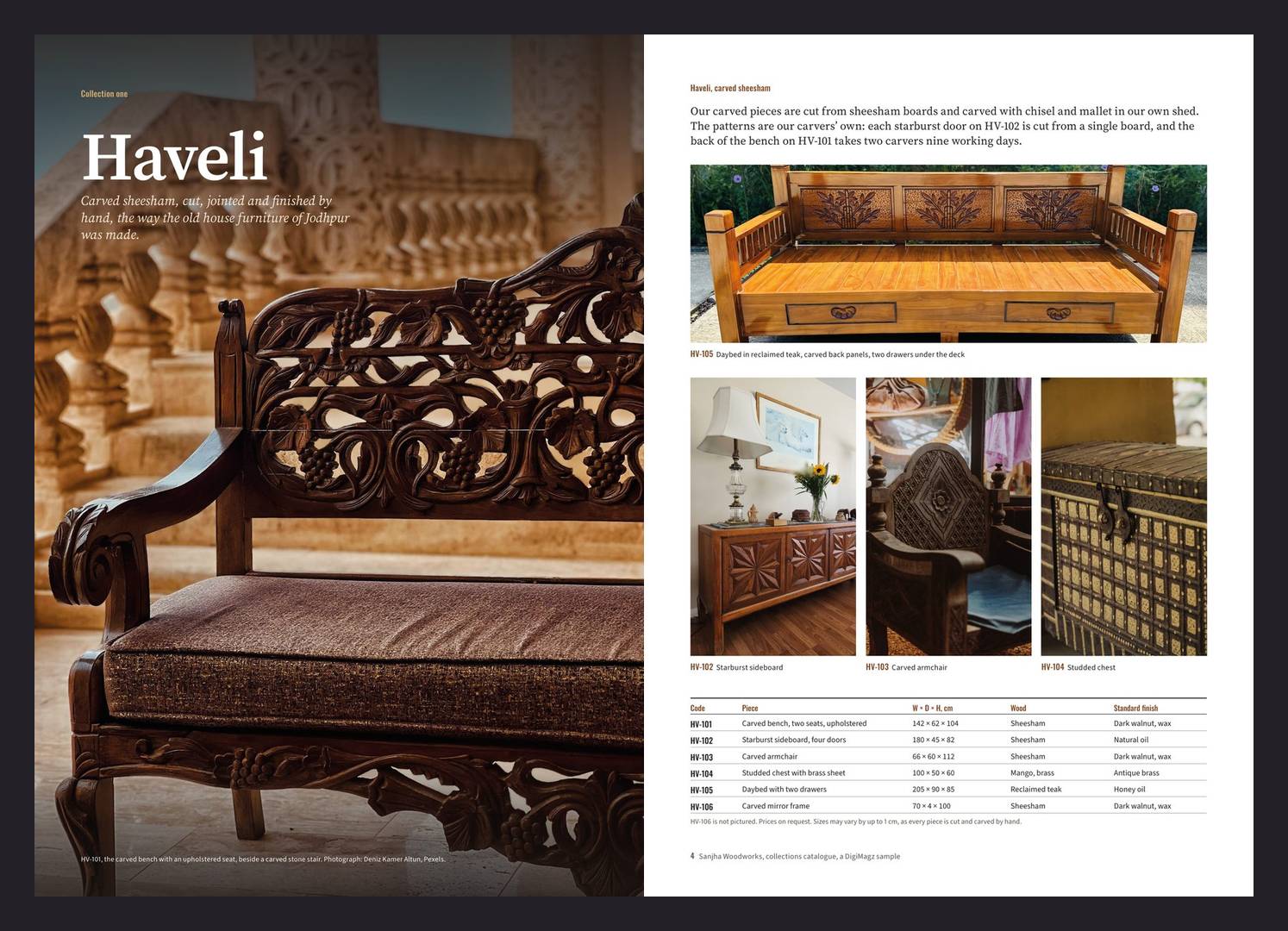
Each of the five collections opens on a single large photograph and a short note on the wood and how it is made. Then the facing page gets down to business: the pieces, each with a code in its caption, and a table listing every code with its size, wood and finish.
The code is the most important thing on the page. It appears under the photograph and again in the table, so a buyer can write "HV-101 in natural finish, 20 pieces" and nothing needs explaining.
Tables a buyer can quote from
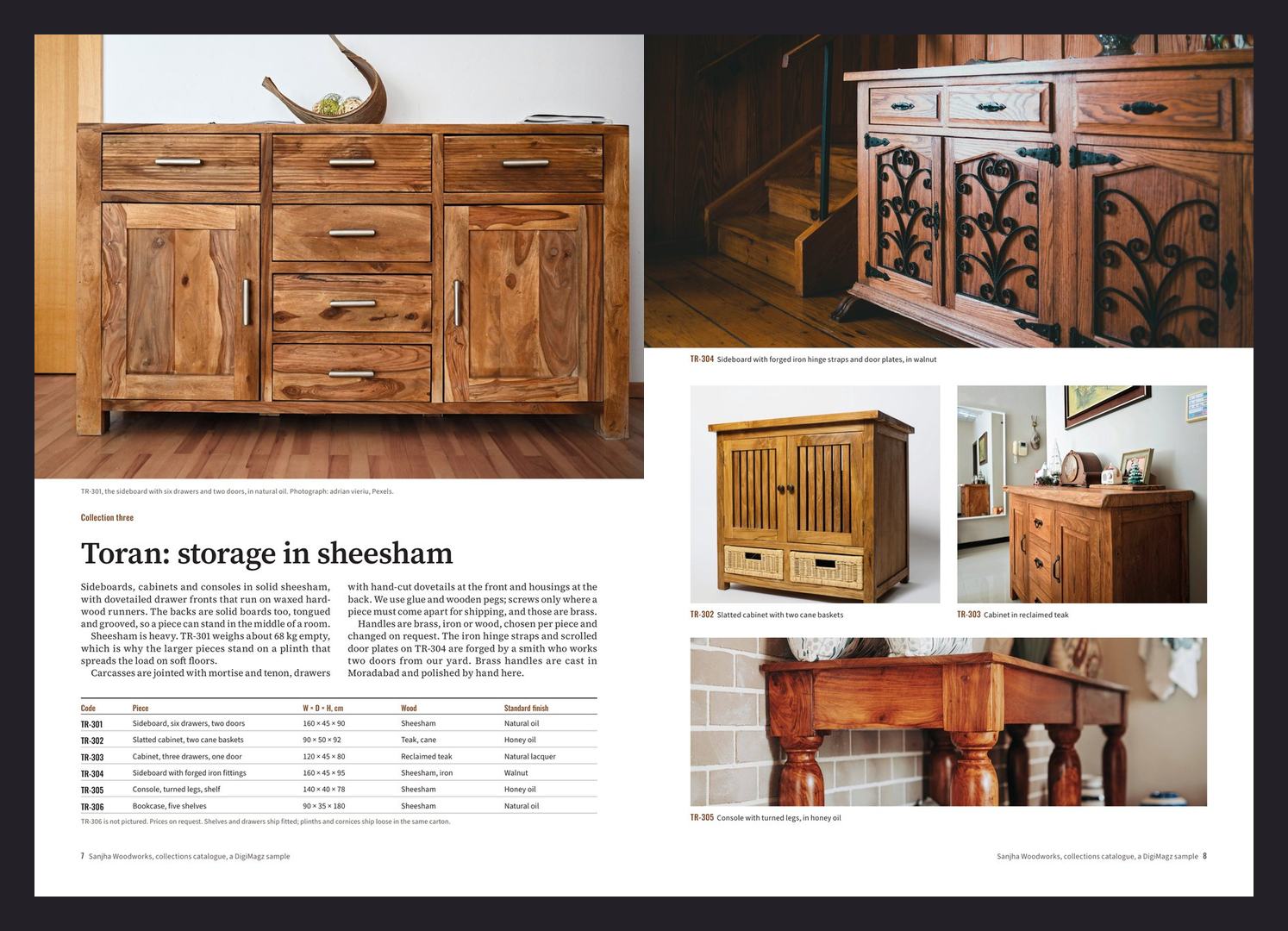
Product tables are where most catalogues get hard to read. Sanjha's tables use the same five columns in every collection (code, piece, size, wood, finish) in the same order, with sizes in centimetres. A buyer comparing two sideboards across collections reads the same row in the same place.
Materials, care and custom orders
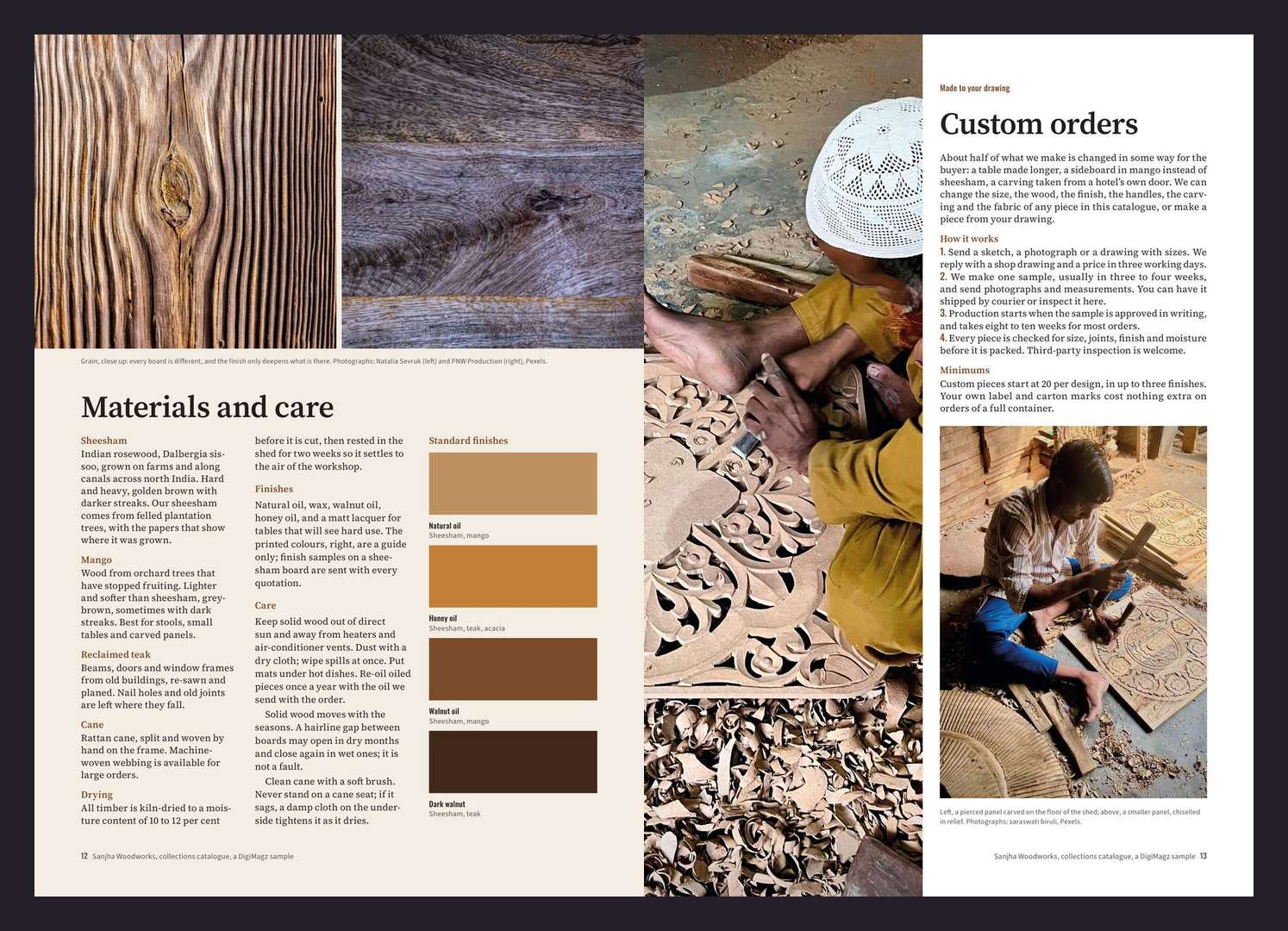
Before ordering, buyers ask the same questions: what is sheesham, how does mango wood age, how do I clean cane. A materials page with grain close-ups and finish swatches answers them once.
Custom orders get their own page: what can be changed (size, wood, finish, handles, carving, fabric), the minimum of 20 pieces per design, and the steps from a sketch to an approved sample to production. The next page sets out ordering and export in plain words: minimum order, packing, lead time and delivery terms. A buyer abroad can go from first look to order without a call.
What separates a good catalogue from an ordinary one
- A code on every product, in the caption and the table.
- The same table on every page, same columns, same order, same units.
- Real photographs of the products, lit the same way across the range, so finishes look true.
- Grouped the way buyers shop: by collection, room or use, not by the order products were made.
- A light PDF for email and WhatsApp, with the print file kept for trade shows and showrooms.
Want one for your products?
We design product catalogues for makers, exporters and brands in India and abroad: furniture, food, machinery, textiles and more. You send the product list, photographs and specifications; the first full proof comes within 10 working days of complete material, with two rounds of revisions included.