Annual report examples: what a good one does on each page
Annual report design examples taken apart page by page, from a 16-page NGO report to a company report cover, with what each page is for and how readers use it.
An annual report has more readers than any other document an organisation makes, and most of them read only a few pages. A donor turns to the money. A board member checks the targets. A journalist looks for one number and one quote. A good annual report is built for that skimming: every page answers one question, and the answer is visible before anyone reads a paragraph.
Below are annual report examples from our studio, taken apart page by page. The main one is a 16-page report for Panghat Foundation, a fictional charity working on water and girls' schooling in Marathwada and Rajasthan. You can turn every page of it, or read its web edition on a phone.
What every annual report needs
Whether it is for a company or a charity, readers expect:
- a cover that says what the year was about;
- a letter from the founder, chair or chief executive;
- the year in numbers;
- the work, programme by programme or business by business;
- results against what was promised;
- where the money came from and where it went;
- who runs the organisation, and how;
- thanks to donors, partners or shareholders, and contact details.
The cover: one outcome, not a mission statement
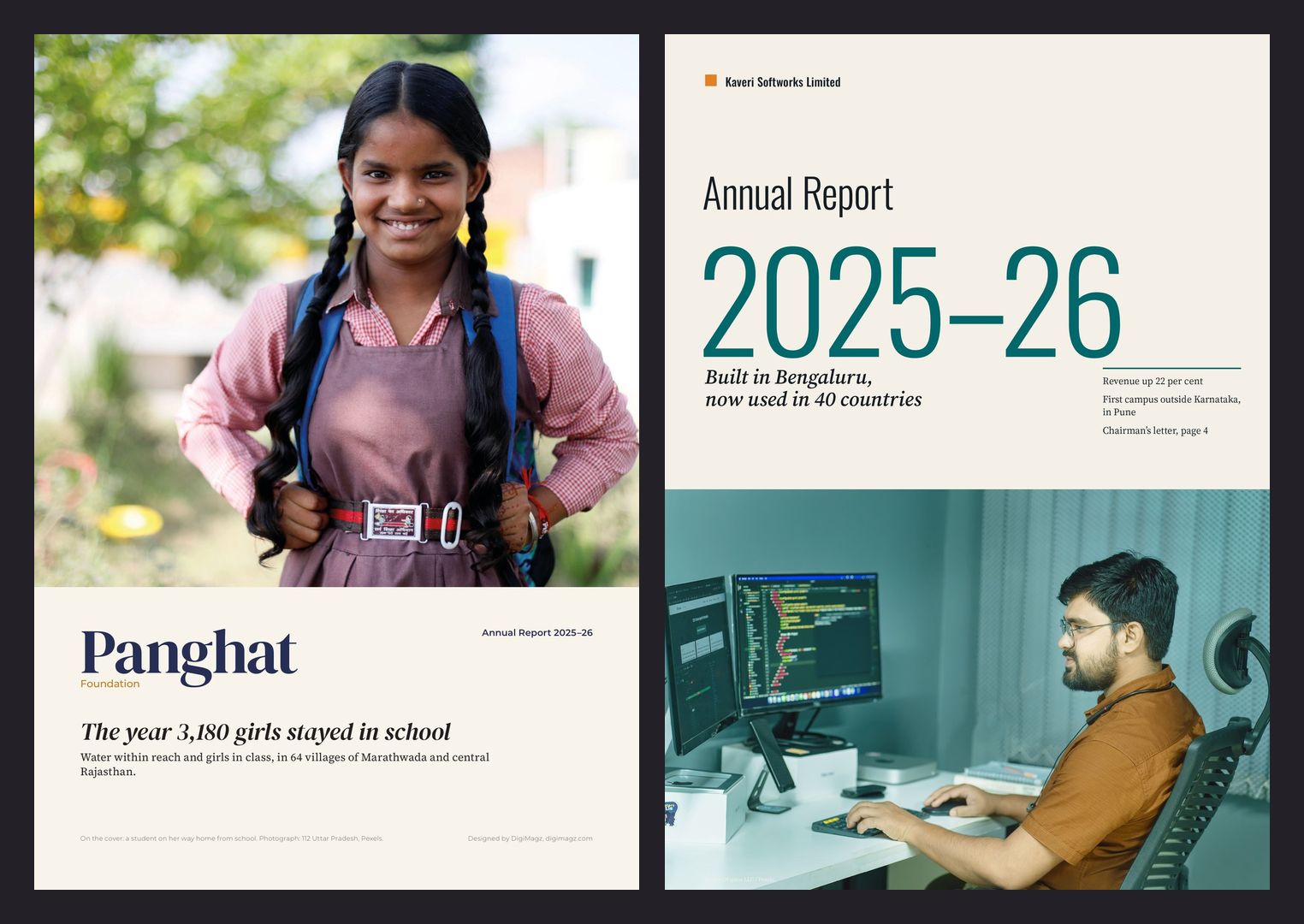
Most annual reports put the organisation's name and a stock photograph on the cover. The Panghat cover leads with the year's result instead: "The year 3,180 girls stayed in school." Someone who reads only the cover still learns what the money did.
A company report reads differently. The Kaveri Softworks cover sets the year, 2025–26, as the largest thing on the page, because on a shelf of reports that is what a reader looks for first. Below it is one documentary photograph of an engineer at his desk, not a glowing globe or a handshake.
The letter, and the year in numbers
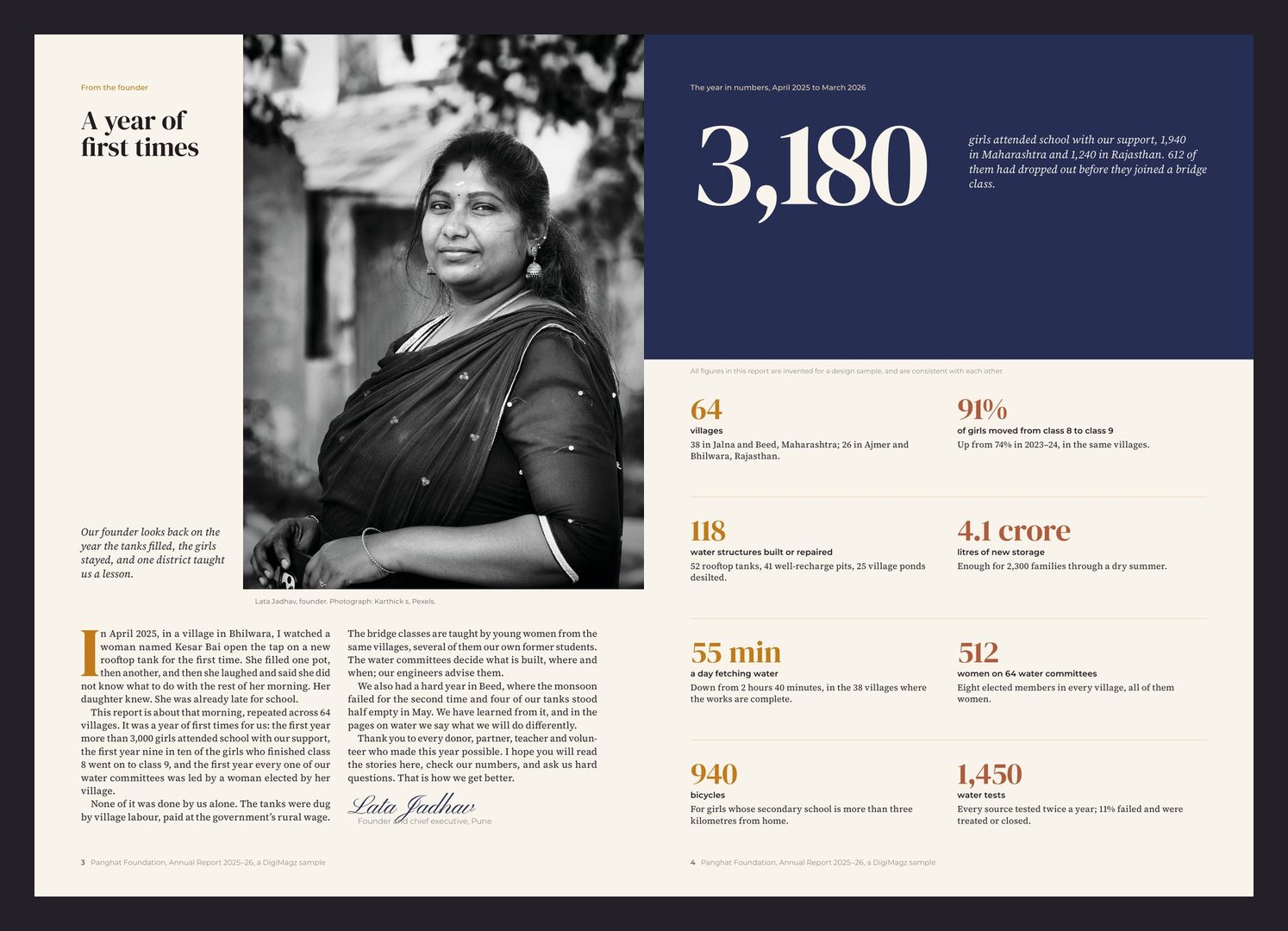
The founder's letter sits beside a plain portrait and is signed by hand. It is the one page written in the first person, so it should sound like a person.
The facing page gives the year in numbers: the main figure large on a dark band, then villages, water structures, time saved and money raised. A reader who stops here has the whole year in a handful of figures.
One person's story
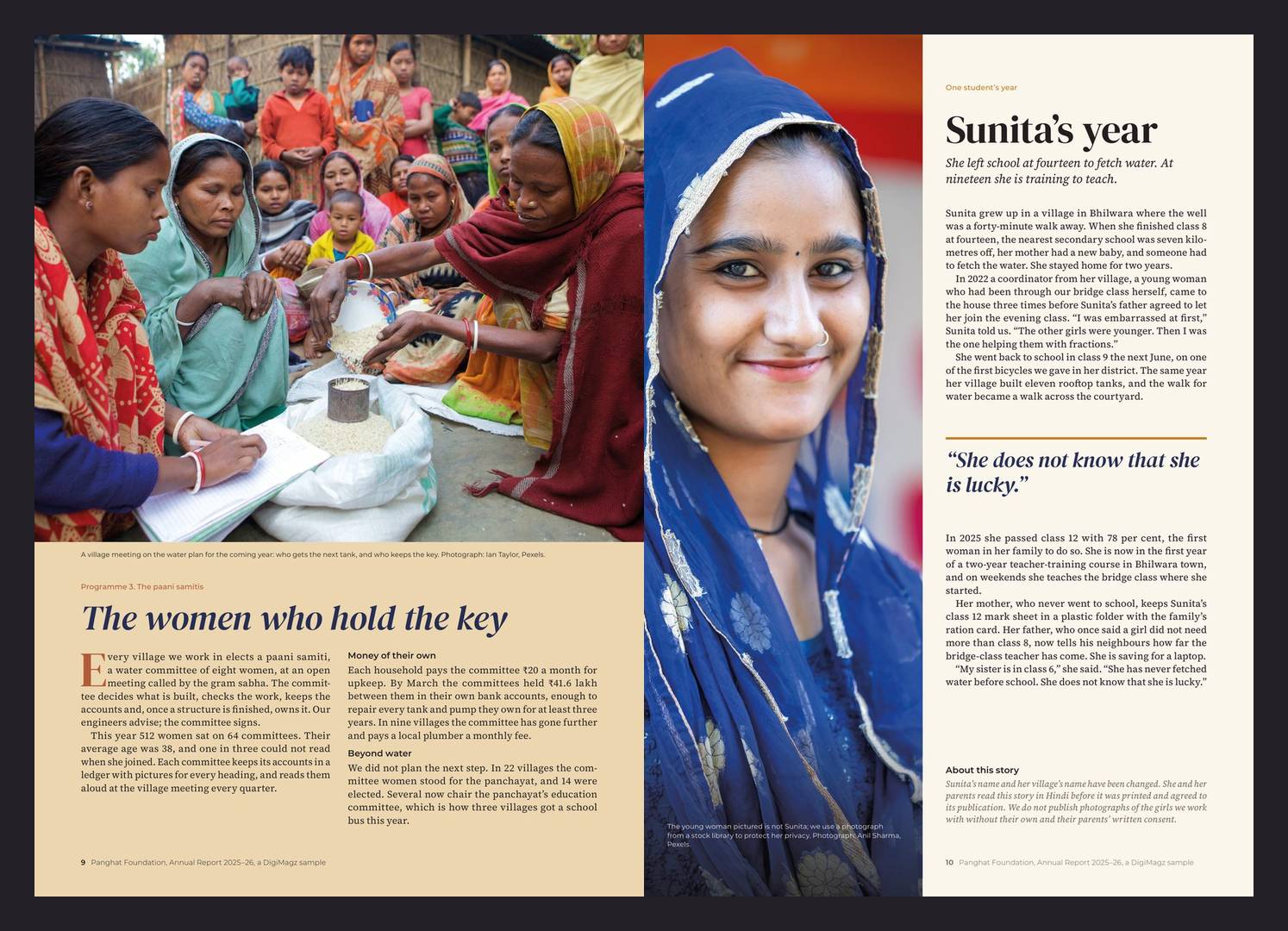
Numbers persuade the board; a story persuades everyone else. Panghat gives one student's year a full page, with a pull quote, and the caption says the photograph is a stock picture used to protect her privacy. Saying that out loud costs nothing and keeps the report honest.
Targets met and missed, and the money
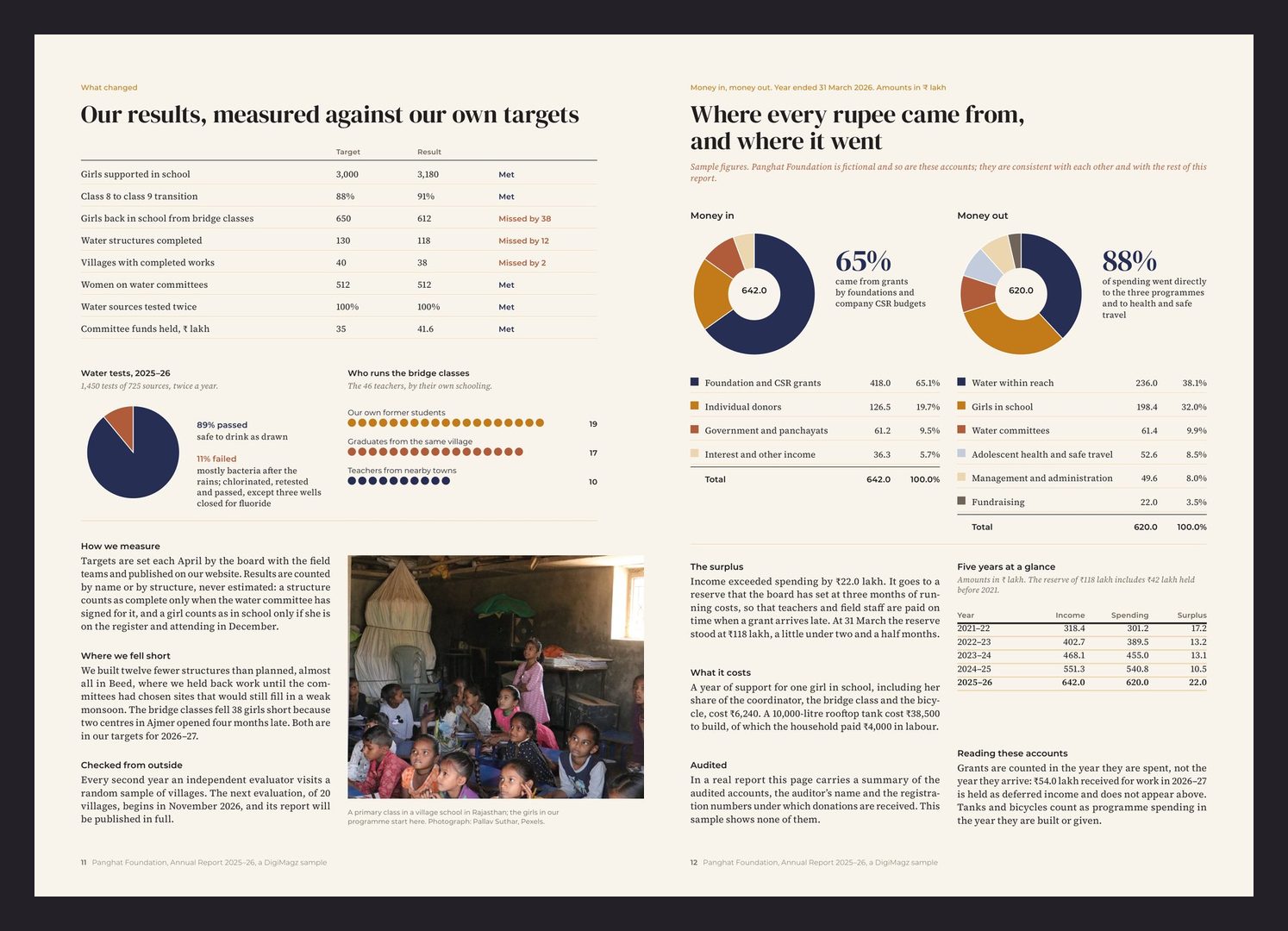
These are the two pages funders read most closely.
Results against targets. A table lists each target, the result and whether it was met, missed ones included. A report that admits one miss is believed on everything else.
Money in, money out. Two donut charts and two tables show where the money came from and where it went, with the share spent on programmes stated plainly. Figures use one unit throughout (here, rupees lakh) so nobody has to convert.
What separates a good annual report from an ordinary one
- It answers one question per page, and the answer is in the headline, not the third paragraph.
- It uses real photographs of the work, and says where a stock picture stands in.
- It shows targets it missed.
- Its charts are drawn to scale, with labels a reader can check against the tables.
- It has a web edition or a light PDF, because most people now open an annual report on a phone. Panghat's web edition shows how the same report works as a page that reflows.
Want one for your organisation?
We design annual reports for companies, and annual reports for nonprofits and foundations, for clients in India and abroad. You send the text, figures and photographs; the first full proof comes within 10 working days of complete material, with two rounds of revisions included.